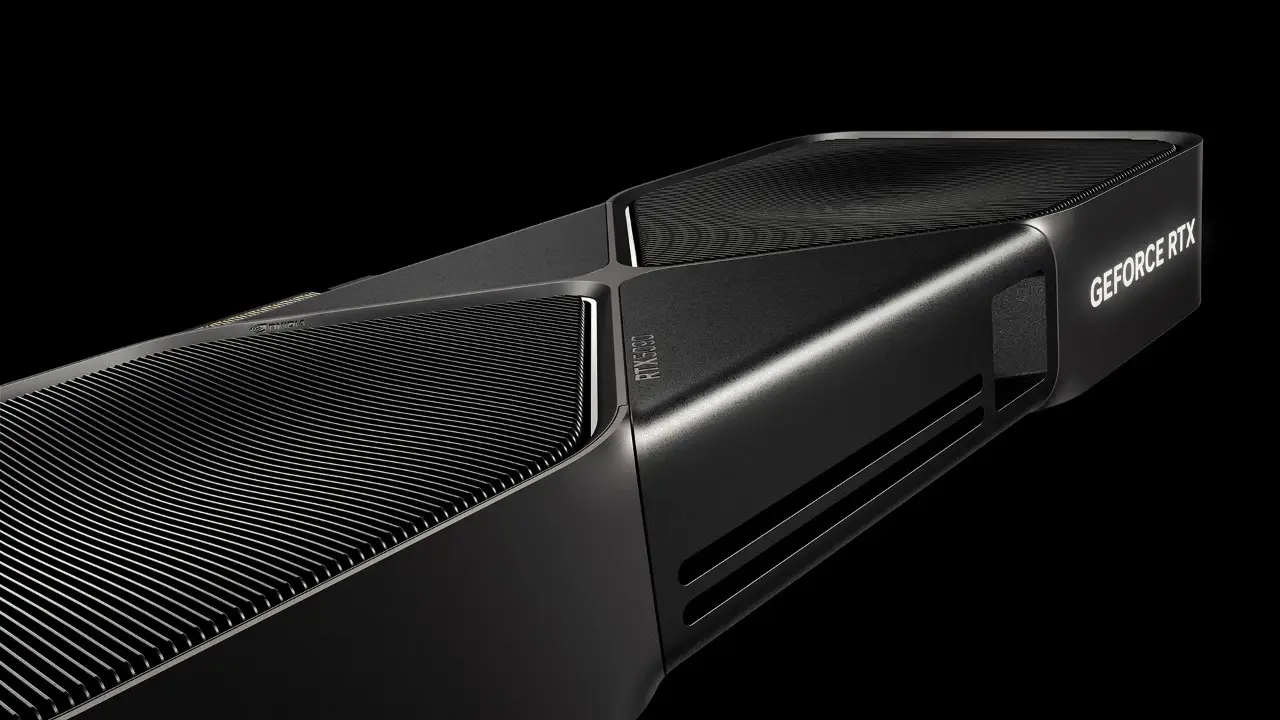
The GeForce RTX 5090 can be difficult to buy at a sensible price, but that does not establish that NVIDIA has discontinued it. The strongest recent public statement points the other way: on October 16, 2026, NVIDIA executive Jeff Fisher denied the rumour that production had ended and said the company would continue shipping the card.
Checked October 22, 2026: This explainer separates reported retail shortages, NVIDIA’s statements and unverified production claims. It is based on source reporting and a limited retail check, not access to factories or distributor shipment records. Cover image: NVIDIA’s official RTX 5090 Founders Edition product image.
Has NVIDIA discontinued the RTX 5090?
According to CNA’s original report from Taipei, Fisher, NVIDIA’s senior vice president of personal computing, rejected the discontinuation claim and reiterated continued supply. 4Gamers’ account of the same post-event interview also reports his acknowledgement that supply-chain capacity is constrained.
NVIDIA says the RTX 5090 is not discontinued. That on-record response carries more weight than an unattributed claim that the product is finished. It does not tell buyers how many cards are being built, when their local shop will receive one, or whether the next shipment will be affordable.
Why can a card still be scarce if it is in production?
There is public evidence of a supply problem broader than one missing shop listing. In its fiscal 2026 annual filing, NVIDIA said it expected supply constraints to weigh on Gaming in the first quarter of fiscal 2027 and beyond. Fisher’s October comments are consistent with continuing constraints, although neither source provides a model-by-model production schedule.
A product being in production does not mean its shipments match demand. Chips still have to become finished boards, reach distributors and arrive at individual retailers. A small or uneven flow can leave buyers seeing repeated sell-outs while cards continue to move through the supply chain. That is an explanation of how shortages work, not a verified map of every missing RTX 5090 shipment.
The buying audience also extends beyond games. NVIDIA lists 32GB of GDDR7 memory and creative and AI uses for the RTX 5090. Those capabilities make interest from creators and local-AI users plausible alongside gaming demand. NVIDIA does not quantify those buyer groups in the sources cited here.
The sources reviewed here do not identify a definitive RTX 5090-specific bottleneck or publish the split between demand and supply causes. Claims about exact memory allocations, factory yields, or an intentional global production shutdown need stronger evidence than empty shelves.
Where the discontinuation rumour came from
On October 10, VideoCardz published a report explicitly tagged as a rumour. It described a claim from MEGAsizeGPU that future GB202 GPU supply would be reserved for NVIDIA’s professional RTX PRO range. A separate claim attributed to hongxing2020 described an alleged factory notification and a possible 24GB RTX 5080 replacement.
Those are specific allocation and roadmap claims, not an NVIDIA end-of-production announcement. Fisher’s October 16 denial directly challenges the claim that the RTX 5090 has ended. Repeating the October 10 story without that later response gives readers an incomplete account.
The claimed move concerns GB202 allocation to RTX PRO products. It should not be expanded into a blanket assertion that finished GeForce cards are being turned into every kind of AI datacenter accelerator. GPU silicon, complete graphics cards and datacenter systems are different things; a rumoured allocation change does not make them interchangeable.
What is confirmed, and what remains unverified?
On a narrow screen, scroll the table horizontally.
| Claim | Evidence | Assessment |
|---|---|---|
| NVIDIA has ended the RTX 5090 | October 10 leak; October 16 executive denial | Discontinuation is not established; NVIDIA denies it |
| Supply is constrained | Annual filing and Fisher’s October comments | Acknowledged by NVIDIA |
| All future GB202 chips are RTX PRO-only | Leaker claim reported by VideoCardz | Unverified allocation claim |
| No new RTX 5090 is available anywhere | Availability varies by country and model | Too broad; one Australian listing showed stock in our check |
| A 24GB RTX 5080 is a confirmed replacement | Separate roadmap rumour | No replacement announcement established by these sources |
Why the AI explanation sounds convincing
NVIDIA’s business is heavily weighted toward datacenter products. Its August 26 financial release reported US$89.0 billion in Data Center revenue out of US$96.2 billion total for fiscal Q2 2027. That provides context for questions about the company’s priorities.
Revenue mix is not a factory allocation report. It does not prove that a particular GeForce production line has stopped or that every additional professional card displaces one RTX 5090. The revenue figures explain the attention on NVIDIA’s priorities, while the allocation claim still needs its own evidence.
Missing listings are a warning sign, not a global verdict
Tom’s Hardware reported on October 15 that Micro Center had changed an RTX 5090 listing to “Not Carried” and that the card had disappeared from NVIDIA’s marketplace. Those are meaningful observations about US retail channels. A retailer’s catalogue decision is still different from a manufacturer announcing that the whole GPU family has reached end of life.
There is also a dated precedent for confusing a store removal with a production end. In a September 2025 response to Tom’s Hardware, NVIDIA said Founders Edition cards remained in production and could disappear from its website when sold out. That older explanation is useful context, not proof of what happened to every listing in October 2026.
Conditions also differ by region. On our October 22 check, Scorptec’s Australian ASUS TUF RTX 5090 page displayed delivery stock and a one-per-household limit. We did not complete a purchase or reserve inventory. It is a dated observation of one board model, not a survey of Australian or global stock.
What buyers should do now
Keep the launch price separate from the price a seller asks today. NVIDIA introduced the RTX 5090 from US$1,999; that was a US starting price, not a promise that every partner card would cost the same or remain available at that price. An expensive marketplace listing is an asking price, not evidence that someone paid it.
Before placing an order, confirm the exact board model, whether stock is physically available or only expected from a supplier, and who provides warranty service in your country. Compare the full delivered price. A listing that accepts payment is not always a firm dispatch commitment.
For gaming, choose around the resolution, frame rate and games you need rather than paying extra because of an end-of-life headline. For local AI, start with the model’s memory requirement and software support. A different GPU may suit the job, but a card with less memory is not automatically an equivalent substitute.
If you already own a 5090, a retail shortage alone says nothing definitive about your card’s remaining driver support or warranty. For hardware specifications and installation checks, see our RTX 5090 specifications and upgrade guide.
The evidence to watch next
A formal NVIDIA product-lifecycle notice, clear statements from board partners and sustained restocking across several retailers would be more useful than another screenshot of a missing listing. None of the sources here supplies a reliable date for a broad restock or a return to launch pricing.
For now, the supported conclusion is narrower than the viral headline: RTX 5090 availability is uneven and supply constraints are acknowledged, while NVIDIA has publicly denied discontinuation. Treat claims about an RTX PRO-only future for its chips as unverified unless stronger evidence emerges.
Sources
- CNA: Fisher denies RTX 5090 discontinuation — CNA
- 4Gamers: RTX 5090 production and supply comments — 4Gamers
- NVIDIA fiscal 2026 Form 10-K — NVIDIA / SEC
- NVIDIA GeForce RTX 5090 product details — NVIDIA
- NVIDIA fiscal Q2 2027 results — NVIDIA
- NVIDIA RTX 50 series launch announcement — NVIDIA
- Tom’s Hardware: October 15 retail-listing observations — Tom’s Hardware
- Tom’s Hardware: September 2025 NVIDIA spokesperson response — Tom’s Hardware
- Scorptec: ASUS TUF RTX 5090 stock listing — Scorptec
- VideoCardz: October 10 RTX 5090 production rumour — VideoCardz