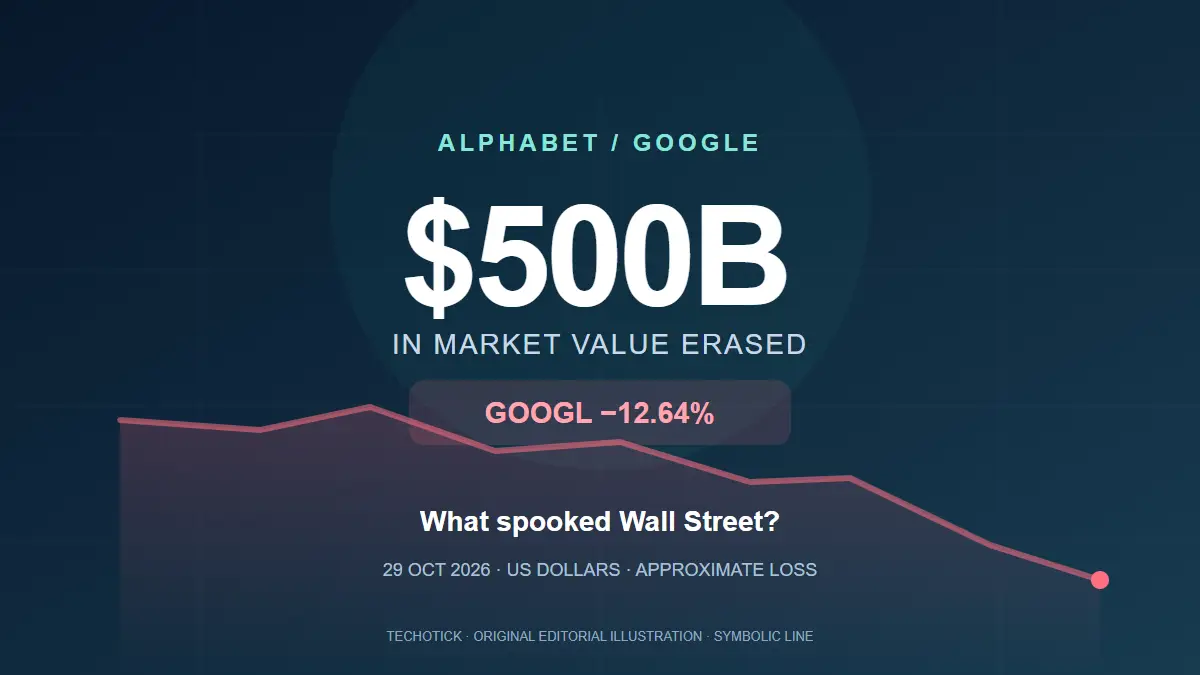
Half a trillion dollars, gone in one trading day. The claim sounds exaggerated, but the central fact checks out: Alphabet, Google’s parent company, lost roughly US$500 billion in stock-market value on October 29, 2026. Australian broadcaster ABC News reported the roughly US$500 billion decline after the US market closed.
The crucial word is value. Google did not report a US$500 billion operating loss or announce that the same amount had vanished from its bank accounts. Investors sharply reduced what they were willing to pay for ownership of the business.
The technology story behind the sell-off is harder to resolve: Google is investing in AI while confronting questions about how well AI search can support its advertising business.
What actually happened to Google’s stock?
Alphabet’s Class A shares, traded as GOOGL, closed at US$283.82 on October 29, down US$41.07, or 12.64%, according to Google Finance. That compares with US$324.89 at the previous close. These are regular-session figures; after-hours prices are a separate measure.
SBS News reported that the day’s sell-off erased about US$500 billion and was Alphabet’s largest daily percentage decline since its stock-market debut. The dollar figure is rounded. It describes Alphabet’s overall valuation, while the 12.64% quote above refers specifically to its Class A shares.
Some live headlines used larger loss estimates. For example, NBC News reported a drop of more than US$550 billion during trading. A session’s worst point and its closing result are different snapshots, so those figures should not be presented as interchangeable.
How can US$500 billion disappear without Google spending it?
Market capitalization is the stock market’s valuation of a company’s outstanding shares. In a simple company with one share class, it is the share price multiplied by the number of shares. Alphabet has multiple share classes, which makes an exact company-wide calculation more involved.
Here is a simplified example, not Alphabet’s actual share structure: a company with 10 billion shares trading at US$100 is worth US$1 trillion on the market. If the price falls to US$90, its market value falls by US$100 billion. The company has not written a US$100 billion cheque.
For shareholders, the price change still matters: their holdings have a lower market value, and selling at that price can lock in a loss relative to their purchase cost. But “market value erased” does not mean the same amount of cash was withdrawn from the company, or that someone else received an equal windfall.
The AI problem hiding inside the sell-off
According to NBC’s reporting on Alphabet’s earnings call, executive Philipp Schindler said Google’s own AI Mode was contributing to weaker search-ad performance because it resulted in fewer ads. He also said the company was experimenting with advertising in the feature.
That creates a difficult balancing act. An AI answer can make search more useful, but usefulness and advertising income are different tests. If people adopt a new search experience faster than Google improves its monetization, product momentum may arrive before the financial payoff.
Our reading is that this is the tension behind the alarm: Google needs to build the next search experience while preserving the business that helps fund it. The results do not establish whether AI search will ultimately become profitable.
Why growth wasn’t enough
Alphabet’s own third-quarter release shows a business still growing: revenue rose 25% to US$127.6 billion, Google Search & other revenue rose 12% to US$63.35 billion, and Google Cloud revenue increased 103% to US$30.7 billion. Chief executive Sundar Pichai also said the Gemini app had reached one billion users.
The same release shows US$42.29 billion of operating cash flow and US$51.355 billion of property-and-equipment purchases. Subtracting those figures gives approximately negative US$9.07 billion of free cash flow for the quarter. That is a different measure from profit: Alphabet reported US$26.17 billion of net income available to common shareholders.
Sales growth, accounting profit and cash generation answer different questions. Infrastructure purchases use cash upfront, while accounting spreads much of their cost over time. Positive earnings can therefore coexist with negative free cash flow.
What would make the next results more reassuring?
For readers following the technology rather than trying to predict tomorrow’s share price, three questions make a useful checklist:
- Can AI search earn more effectively? Watch for evidence about advertising performance, rather than treating query growth alone as the answer.
- Can infrastructure spending translate into cash generation? Compare operating cash flow with capital expenditure alongside headline profit.
- Can Cloud growth and Search economics improve together? Strength in one business does not automatically settle concerns about another.
One trading day cannot establish the final outcome of Google’s AI strategy. It can show how abruptly expectations change when investors question the connection between adoption, spending and returns.
The verdict: the roughly US$500 billion market-value loss is real. Describing it as US$500 billion in lost cash or an operating loss would misstate what happened. The story is a sharp repricing of Alphabet’s future—and a warning that AI popularity still has to translate into financial returns.
Figures refer to the October 29, 2026 US trading session and Alphabet’s third quarter of 2026. All dollar amounts are US dollars. This is a researched technology-business explainer, not an investment recommendation. Reporting synthesis, editing and the original vector illustration were prepared with AI assistance.
Sources
- Alphabet Class A regular-session stock quote — Google Finance
- Alphabet Q3 2026 earnings release — Alphabet Investor Relations
- Google-parent Alphabet stock-price plunge and AI advertising concerns — NBC News
- October 30 Australian markets coverage of Alphabet’s overnight sell-off — ABC News Australia
- Alphabet loses US$500 billion in market cap in one day — SBS News Korea
- Market capitalization — US Securities and Exchange Commission, Investor.gov