A Val Town app can open at its new address while the automation behind it has stopped working. Your browser can reach the new page while the service sending automated events still uses the old address. Even a successful response from the new endpoint does not show that the expected database update or notification happened.
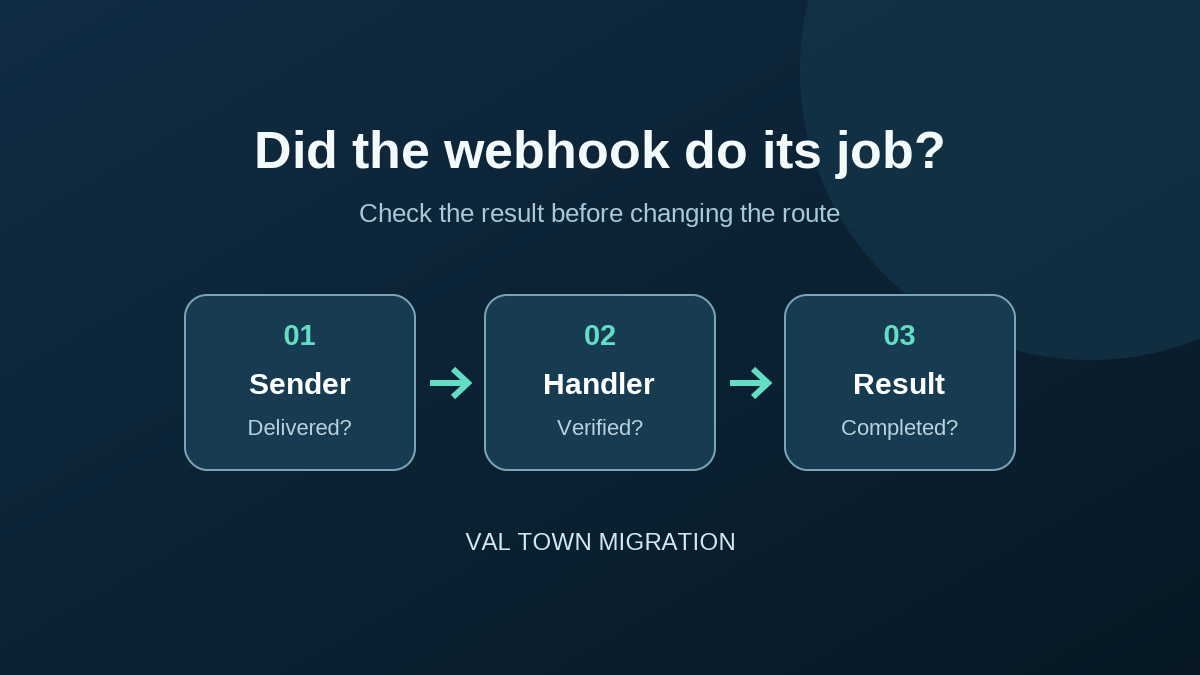
A webhook is an automated request one service sends when an event occurs. When moving one off Val Town, verify the full path from sender to result before changing the old URL. Val Town's 10 November shutdown announcement gives two relevant deadlines: code becomes read-only on 10 December 2026, with SQLite and blob storage excepted from that stage; all other services end on 10 January 2027. The announcement does not specify a cutoff timezone. Plan ahead of those dates rather than assuming midnight in your location.
A redirect changes where requests go
Val Town's redirect documentation says that setting a redirect immediately stops the val receiving requests. Redirects preserve the path and query string by default, unless you change that setting. That is useful for old links, but Val Town explicitly warns that many webhook senders do not follow redirects. Update the destination in each sending service directly.
There is also an earlier commitment than the January shutdown: redirects can be added or edited until 10 December, when configured redirects become permanent. The documented mechanism covers *.val.run addresses; a custom domain needs its own DNS change. Do not switch a redirect merely because the new homepage loads.
Give each webhook an acceptance record
Before changing production, write down the sender, event type, current endpoint, new endpoint, authentication method and expected result. Include the database or queue the new code uses. Check that the replacement has the required data, including any record of events already processed. A fresh, empty database can lose the information the handler uses to avoid repeating work.
Use a disposable record and a test project or sandbox where the provider supports one. This is our suggested acceptance checklist, not a claim that every provider has the same delivery controls:
| Check | Evidence to keep |
|---|---|
| Delivery | Sender's delivery ID, destination and response. |
| Authentication | Valid event accepted; invalid signature rejected. |
| Processing | The expected row, file or test notification exists. |
| Repeat delivery | The same event causes no unwanted duplicate effect. |
Compare the intended action with the actual result, including which account or environment received it. Keep delivery IDs and timestamps in the record; keep tokens, signing secrets and sensitive payloads out of screenshots and shared notes.
A green delivery is only one part of the test
GitHub provides a concrete example. Its webhook guidance calls for a 2xx response within 10 seconds and describes queueing work to process it asynchronously. A quick acknowledgement can therefore precede the actual work. Check the worker and the result as well as the delivery status.
For a fictional example, suppose a GitHub issue event should create one tracking row. The new endpoint returns 200, but the worker points to a staging database. Delivery passed; the production outcome did not. After correcting the configuration, use a fresh disposable event to verify the intended destination. Check the earlier attempt separately before deciding whether it needs replaying. This is an illustrative failure case, not an observed Val Town incident.
GitHub also documents that a requested redelivery retains the same X-GitHub-Delivery value. Test how your handler treats that repeat. Distinguish an event that was received from one whose work completed. Repeating a completed event should not create another tracking row; an incomplete attempt needs a recovery path. Recording an event as finished before its work succeeds can suppress the recovery you need.
Preserve authentication during the move
A webhook normally arrives without your browser's signed-in session. A new host's login screen may let you view the app while blocking the sender. Val Town's access migration guide distinguishes callbacks from human access and warns against removing the whole app's protection to make one callback work.
Configure the intended callback route and retain the provider's request verification. For GitHub, the signature validation guide explains how to verify the payload with the webhook secret before processing it. Store the secret in the replacement host's secret settings. A delivery reaching the handler does not by itself establish that it came from the expected sender.
Switch one sender, then account for missed events
Once the new handler and its data are ready, change the sender's configured URL and verify a fresh event through that exact route. Record the change time. Inspect failures around the transition and reconcile their results before replaying anything that could create another message, row or charge.
Do not assume the provider will retry for you. GitHub does not automatically redeliver failed webhooks; its documentation describes manual redelivery and scripted recovery. Other providers have their own rules. Check those rules for each integration, and retain enough state to distinguish a missed event from an already-completed one.
After verifying the moved app and synchronising its data, set any needed old-link redirect, following the Val Town migration guide. Keep browser-link checks separate from webhook checks in your record. Mark the integration complete when the configured sender reaches the new handler, the expected result appears, and repeat or failed deliveries have a verified recovery path.
Method: This guide combines current Val Town and GitHub documentation with Techotick's proposed acceptance checklist and fictional example. We did not migrate a live account or test provider deliveries. Prepared with AI assistance and editorial review; no sponsorship or affiliate links. Cover: original Techotick vector illustration of a webhook workflow, not a product screenshot.
Sources
- Val Town is winding down — Val Town
- Redirecting val.run URLs — Val Town
- Migration guide — Val Town
- Migrate Access — Val Town
- Best practices for using webhooks — GitHub
- Validating webhook deliveries — GitHub
- Handling failed webhook deliveries — GitHub